
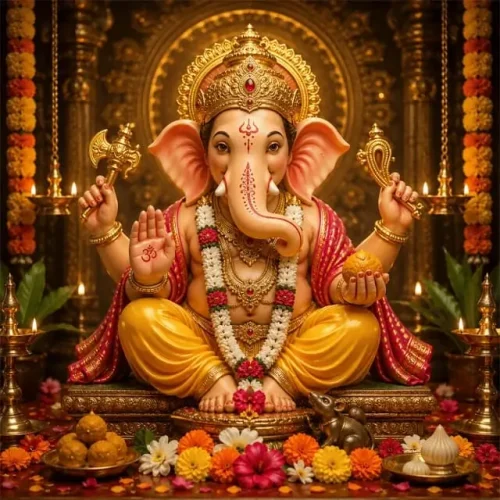
Shri Ganesh Ashtakam (श्री गणेशाष्टकम्) is a devotional hymn dedicated to Lord Ganesha, traditionally recited to seek the removal of obstacles. It can be recited as a daily prayer or during puja, especially on Wednesday, during Ganesh Chaturthi, or at the beginning of auspicious activities.
Shri Ganesh Ashtakam
श्री गणेशाष्टकम्

श्री गणेशाय नमः।
सर्वे उचुः।
यतोऽनन्तशक्तेरनन्ताश्च जीवा
यतो निर्गुणादप्रमेया गुणास्ते।
यतो भाति सर्वं त्रिधा भेदभिन्नं
सदा तं गणेशं नमामो भजामः॥1॥
यतश्चाविरासीज्जगत्सर्वमेतत्तथाऽब्जासनो
विश्वगो विश्वगोप्ता।
तथेन्द्रादयो देवसङ्घा मनुष्याः
सदा तं गणेशं नमामो भजामः॥2॥
यतो वह्निभानू भवो भूर्जलं च
यतः सागराश्चन्द्रमा व्योम वायुः।
यतः स्थावरा जङ्गमा वृक्षसङ्घा
सदा तं गणेशं नमामो भजामः॥3॥
यतो दानवाः किन्नरा यक्षसङ्घा
यतश्चारणा वारणाः श्वापदाश्च।
यतः पक्षिकीटा यतो वीरूधश्च
सदा तं गणेशं नमामो भजामः॥4॥
यतो बुद्धिरज्ञाननाशो मुमुक्षोर्यतः
सम्पदो भक्तसन्तोषिकाः स्युः।
यतो विघ्ननाशो यतः कार्यसिद्धिः
सदा तं गणेशं नमामो भजामः॥5॥
यतः पुत्रसम्पद्यतो वाञ्छितार्थो
यतोऽभक्तविघ्नास्तथाऽनेकरूपाः।
यतः शोकमोहौ यतः काम एव
सदा तं गणेशं नमामो भजामः॥6॥
यतोऽनन्तशक्तिः स शेषो बभूव
धराधारणेऽनेकरूपे च शक्तः।
यतोऽनेकधा स्वर्गलोका हि नाना
सदा तं गणेशं नमामो भजामः॥7॥
यतो वेदवाचो विकुण्ठा मनोभिः
सदा नेति नेतीति यत्ता गृणन्ति।
परब्रह्मरूपं चिदानन्दभूतं
सदा तं गणेशं नमामो भजामः॥8॥
।। श्रीगणेश उवाच ।।
पुनरूचे गणाधीशः स्तोत्रमेतत्पठेन्नरः ।
त्रिसन्ध्यं त्रिदिनं तस्य सर्वकार्यं भविष्यति ॥ 9 ॥
यो जपेदष्टदिवसं श्लोकाष्टकमिदं शुभम् ।
अष्टवारं चतुर्थ्यां तु सोऽष्टसिद्धीरवाप्नुयात् ॥ 10 ॥
यः पठेन्मासमात्रं तु दशवारं दिने दिने ।
स मोचयेद्बन्धगतं राजवध्यं न संशयः ॥ 11 ॥
विद्याकामो लभेद्विद्यां पुत्रार्थी पुत्रमाप्नुयात् ।
वाञ्छिताँल्लभते सर्वानेकविंशतिवारतः ॥ 12 ॥
यो जपेत्परया भक्त्या गजाननपरो नरः ।
एवमुक्त्वा ततो देवश्चान्तर्धानं गतः प्रभुः ॥ 13 ॥
इति श्रीगणेशपुराणे उपासनाखण्डे श्रीगणेशाष्टकम् ।
About Shri Ganesh Ashtakam
The Shri Ganesh Ashtakam is traditionally found in the Upasana Khanda of the Ganesh Purana. Its eight verses describe Lord Ganesha as the source behind the visible and invisible aspects of creation and ultimately as the Parabrahma, the supreme divine reality. The eight principal verses of Shri Ganesh Ashtakam praise Lord Ganesha as the divine source of creation, wisdom, spiritual knowledge and the removal of obstacles.
Children and students may find the hymn particularly meaningful because several verses refer to Buddhi (बुद्धि), Vidya (विद्या) and the removal of ignorance. The concluding verses of the hymn, known as its Phalashruti (फलश्रुति), describe the traditional spiritual benefits associated with its recitation.
Shri Ganesh Ashtakam Importance and Significance
The importance of Shri Ganesh Ashtakam lies in both its devotional and philosophical content.
The first eight verses repeatedly offer worship to Lord Ganesha with the words:
सदा तं गणेशं नमामो भजामः
which expresses the devotional attitude of continually bowing to and worshipping Lord Ganesha.
The verses describe Ganesha as the source of different forms of existence, including divine beings, human beings, animals, plants and the elements of nature.
The fifth verse gives particular importance to Buddhi (intelligence), removal of ignorance, destruction of obstacles and Karya Siddhi (success in one’s work).
The final verse presents a deeper philosophical view by describing Lord Ganesha as Parabrahma, the supreme reality, and as Chidananda, associated with consciousness and bliss.
Therefore, Ganesh Ashtakam can be understood at two levels:
Devotional Significance
It is a prayer seeking the blessings of Lord Ganesha for wisdom, removal of obstacles and success in one’s responsibilities.
Spiritual Significance
It presents Lord Ganesha as the supreme divine principle behind creation and as the ultimate spiritual reality.
Shri Ganesh Ashtakam Puja Samagri
There is no need for an elaborate setup to recite the Ashtakam. Depending on your पूजा tradition, you may use:
- Lord Ganesha’s idol or picture
- दीपक
- धूप or incense
- दूर्वा grass
- Flowers
- Fruits
- Modak or ladoo
- नैवेद्य
- Water
- Kumkum
- Akshat (rice)
The पूजा सामग्री may vary according to family and regional traditions. The availability of every item is not a requirement for simply reciting Shri Ganesh Ashtakam.
Shri Ganesh Ashtakam Path / Puja Vidhi
A simple Ganesh Ashtakam Path Vidhi can be followed at home.
Step 1: Clean the Puja Place
Clean the place where you will perform your पूजा and keep the surroundings peaceful.
Step 2: Take a Bath and Wear Clean Clothes
Step 3: Place Lord Ganesha’s Image or Idol
Step 4: Light a Diya
Light a दीपक and, according to your पूजा tradition, incense or धूप.
Step 5: Offer Prayers to Lord Ganesha
Begin by remembering Lord Ganesha and offering your prayer. You may chant:
ॐ गं गणपतये नमः।
Step 6: Offer Puja Items
Offer flowers, दूर्वा, फल, नैवेद्य or other पूजा सामग्री according to your tradition and availability.
Step 7: Recite Shri Ganesh Ashtakam
Read the complete श्री गणेशाष्टकम् slowly and clearly.
Try to understand the meaning of the verses rather than rushing through the recitation.
Step 8: Read the Phalashruti
After completing the eight verses, you may recite the concluding verses of the Shri Ganesh Ashtakam.
Step 9: Offer Your Prayer
At the end, pray to Lord Ganesha for wisdom, strength, removal of obstacles and the ability to perform your responsibilities properly.
Shri Ganesh Ashtakam Benefits
The Shri Ganesh Ashtakam benefits are described particularly in the verses that follow the eight main shlokas. These verses form the फलश्रुति (Phalashruti) of the hymn.
According to the traditional Phalashruti, reciting Ganesh Ashtakam with devotion is associated with several spiritual and devotional benefits.
1. Removal of Obstacles
Lord Ganesha is traditionally worshipped as Vighnaharta, the remover of obstacles. The fifth verse of Shri Ganesh Ashtakam specifically mentions the destruction of obstacles and the accomplishment of one’s work.
Therefore, devotees may recite Ganesh Ashtakam for removing obstacles before beginning an important task.
2. Success in Auspicious Work
The hymn mentions कार्यसिद्धि (Karya Siddhi), meaning accomplishment or successful completion of one’s work.
Devotees traditionally remember Lord Ganesha before starting important activities and may include Shri Ganesh Ashtakam in their prayer.
3. Gain of Knowledge and Wisdom
The fifth verse refers to बुद्धि and the destruction of ignorance. For this reason, Ganesh Ashtakam is especially meaningful for devotees seeking wisdom, knowledge and clarity of understanding.
Students may also recite the hymn as part of their regular prayer.
4. Fulfillment of Desires
The Phalashruti states that a person who recites the hymn with devotion may attain desired objects or wishes.
This is traditionally understood as a devotional फलश्रुति rather than a guarantee of a particular material result.
5. Blessings for Children and Family
The Phalashruti mentions the fulfillment of the desire for a son and other desired results. This reflects the traditional religious context of the hymn.
6. Attainment of Vidya
The Phalashruti states: विद्याकामो लभेद्विद्यां meaning that one who desires knowledge may attain Vidya (विद्या).
7. Relief from Sorrow and Delusion
The sixth verse refers to शोक and मोह. The devotional significance of the verse is that remembrance of Lord Ganesha is associated with overcoming sorrow, attachment and delusion.
8. Spiritual Benefits
The final verses identify Lord Ganesha with the supreme spiritual reality, Parabrahma, and describe Him as Chidananda, the nature of consciousness and bliss.
Thus, Shri Ganesh Ashtakam is not only a prayer for worldly success but also contains a deeper spiritual understanding of Lord Ganesha.
When to Read Shri Ganesh Ashtakam?
Shri Ganesh Ashtakam can be recited as part of regular worship and during occasions associated with Lord Ganesha.
You can recite Shri Ganesh Ashtakam:
- During daily morning prayers
- During Ganesh Puja
- On Wednesday
- On Ganesh Chaturthi
- On Sankashti Chaturthi
- Before beginning an auspicious activity
- Before starting an important work
- Before examinations or important studies
- When seeking Lord Ganesha’s blessings for a new beginning
- During personal meditation and devotional practice
There is no need to restrict the recitation only to a particular festival. A devotee can remember Lord Ganesha and recite the Ashtakam with श्रद्धा and devotion according to their personal practice.
How Many Times to Read Shri Ganesh Ashtakam?
The Shri Ganesh Ashtakam Phalashruti gives specific instructions about the number and duration of recitations.
According to the concluding verses:
- Recitation three times a day for three days is mentioned in verse 9.
- Recitation for eight days is mentioned in verse 10.
- Eight recitations on Chaturthi are specifically mentioned.
- Ten recitations every day for one month are mentioned in verse 11.
- Twenty-one recitations are mentioned in verse 12 in connection with desired results.
The relevant traditional verses should therefore be understood in the context of the Phalashruti of Shri Ganesh Ashtakam.
For ordinary daily worship, devotees may also recite the Ashtakam once with devotion rather than treating a particular number as compulsory.
Best Day / Auspicious Occasions to Read Ganesh Ashtakam
Wednesday
Wednesday (Budhwar) is traditionally associated with Lord Ganesha. Devotees who wish to recite Ganesh Ashtakam on a particular weekday may choose Wednesday.
Ganesh Chaturthi
Ganesh Chaturthi is one of the most important occasions for worshipping Lord Ganesha. Reciting Shri Ganesh Ashtakam on Ganesh Chaturthi can be included as part of Ganesh Puja.
Sankashti Chaturthi
Sankashti Chaturthi is traditionally dedicated to Lord Ganesha. Devotees observing this occasion may include Ganesh Ashtakam in their prayers.
Before Starting New Work
Lord Ganesha is traditionally remembered before beginning an auspicious activity. Shri Ganesh Ashtakam can therefore be recited before starting a new project, entering a new home, beginning studies or undertaking another important activity.
Daily Prayer
There is no requirement that Ganesh Ashtakam must only be recited on a festival. Devotees can include it in their daily पूजा and prayer routine.
Best Time to Read Shri Ganesh Ashtakam
The best time to read Ganesh Ashtakam is generally during one’s prayer or पूजा time.
Morning
Morning after bathing and getting ready for पूजा is a suitable time for devotional recitation. The quiet atmosphere can also make it easier to concentrate on the prayer.
During Ganesh Puja
Ganesh Ashtakam can be recited during Lord Ganesha Puja, along with other prayers and offerings.
Evening
Devotees who cannot recite it in the morning may recite Shri Ganesh Ashtakam during their evening prayer.
Frequently Asked Questions About Shri Ganesh Ashtakam
What is Shri Ganesh Ashtakam?
Shri Ganesh Ashtakam (श्री गणेशाष्टकम्) is an eight-verse devotional hymn dedicated to Lord Ganesha. It praises Lord Ganesha as the divine source of creation, wisdom, removal of obstacles and the supreme spiritual reality.
What are the benefits of Shri Ganesh Ashtakam?
According to its traditional Phalashruti, Shri Ganesh Ashtakam is associated with removal of obstacles, कार्यसिद्धि, wisdom, Vidya, fulfillment of desires and other spiritual benefits.
When should I read Shri Ganesh Ashtakam?
You can read Ganesh Ashtakam during daily पूजा, in the morning or evening, on Wednesday, during Ganesh Chaturthi, on Sankashti Chaturthi, or before beginning an auspicious activity.
Can I read Shri Ganesh Ashtakam every day?
Yes. Devotees can include Shri Ganesh Ashtakam in their daily prayer routine and recite it with devotion and concentration.
What is the best time to read Ganesh Ashtakam?
Morning during पूजा is a convenient and traditionally suitable time. However, devotees can also recite it during evening पूजा or another suitable time according to their daily routine.
How many times should Ganesh Ashtakam be recited?
The Phalashruti mentions several specific recitation practices, including three times daily for three days, eight recitations on Chaturthi, ten times daily for one month and twenty-one recitations. For regular पूजा, it can also be recited once with devotion.
Can students read Shri Ganesh Ashtakam?
Yes. The hymn refers to Buddhi, knowledge and Vidya, making it particularly meaningful for students who wish to include Lord Ganesha’s worship in their prayer routine.
Can children read Ganesh Ashtakam?
Yes. Children can recite or listen to Shri Ganesh Ashtakam as part of their devotional practice. Parents can help children learn the Sanskrit verses gradually.
Can women read Shri Ganesh Ashtakam?
Yes. Women who wish to worship Lord Ganesha can include Shri Ganesh Ashtakam in their devotional prayer according to their family and personal पूजा traditions.
Can Ganesh Ashtakam be read on Wednesday?
Yes. Wednesday is traditionally associated with Lord Ganesha, and devotees may choose Wednesday for Ganesh Ashtakam recitation.
Can I read Shri Ganesh Ashtakam on Ganesh Chaturthi?
Yes. Ganesh Chaturthi is an especially appropriate occasion for Lord Ganesha worship, and Shri Ganesh Ashtakam can be included in the Ganesh Chaturthi Puja.
What should be offered while reading Ganesh Ashtakam?
Devotees may offer traditional items such as Durva grass, flowers, modak or ladoo, fruits, नैवेद्य and a दीपक. The exact पूजा सामग्री may differ according to individual and regional traditions.
Is there a specific rule for reading Shri Ganesh Ashtakam?
The most important aspects of devotional recitation are श्रद्धा, devotion and concentration. The Phalashruti does mention specific recitation counts for particular purposes, but ordinary devotees may include the Ashtakam in their regular prayer according to their practice.
Where is Shri Ganesh Ashtakam mentioned?
The concluding verse identifies the hymn as Shri Ganesh Ashtakam from the Upasana Khanda of the Ganesh Purana:
इति श्रीगणेशपुराणे उपासनाखण्डे श्रीगणेशाष्टकम्।
What does Ashtakam mean?
The Sanskrit word Ashtakam is related to Ashta, meaning eight. In devotional literature, an Ashtakam generally refers to a hymn consisting of eight principal verses. Shri Ganesh Ashtakam contains eight main verses followed by its Phalashruti.